Place details
Museo Etnografico
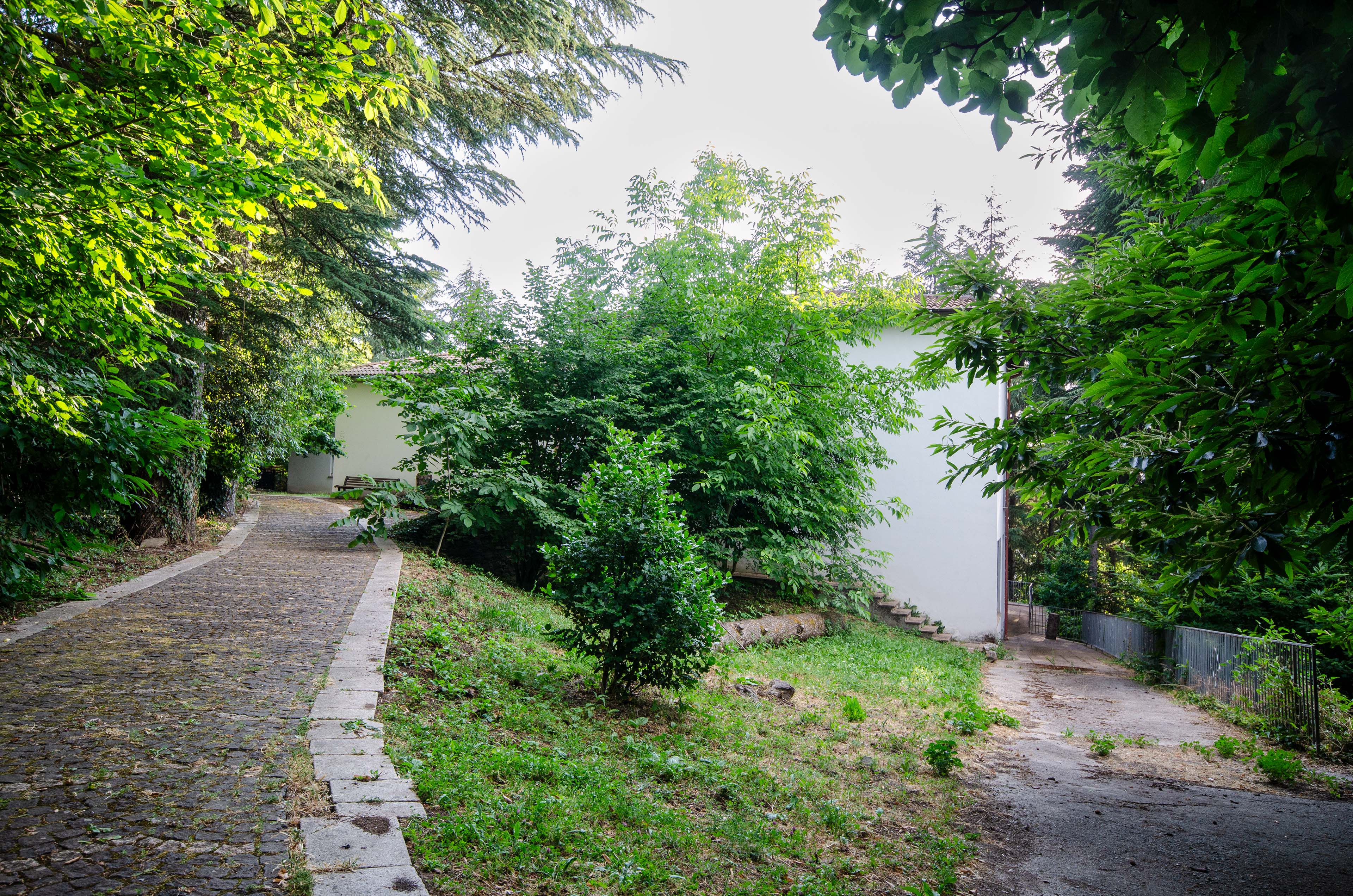
The Ethnographic Museum is housed in the Pastissu Park. The visit follows an exhibition itinerary through 8 themed rooms, in which artefacts relating to the material culture of central Sardinia are exhibited.
The museum recounts the traditional life and economy associated with the agro-silvo-pastoral system, with a particular focus on the collection, processing, distribution, and consumption of food resources. It also exhibits tools and testimonies related to craftsmanship, the itinerant trade of forest fruits, religious devotion, popular music, traditional clothes and candle making.
The exhibition also recounts the ancient snow collection, which made Aritzo the heart of the ice trade in Sardinia for centuries, and the preparation of the famous Carapigna, the traditional Aritzo sorbet.
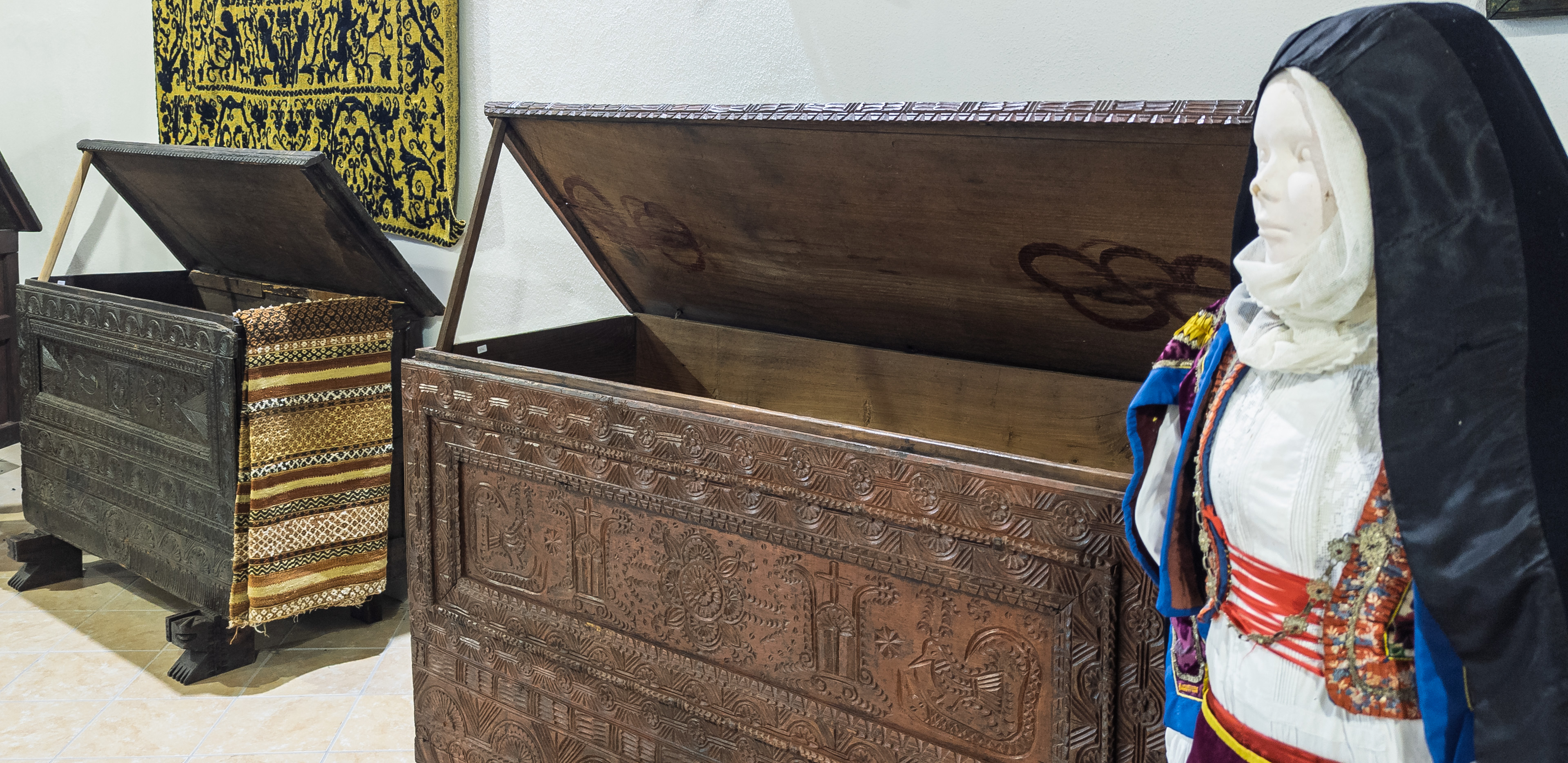
The visit ends with an evocative section dedicated to the costumes and masks of the Barbagia carnival. Among the rarest objects are the traditional Aritzo chests, hand-carved and used to store bread and linen, 17th-century pewter sorbet containers and an ancient wooden press for pomace.
The museum is part of the Ecomuseum of the Sardinian Mountains, which also includes Casa Devilla, the Spanish Prison, the Mura Museum and the paths of the ancient Neviere.
.
Viale Kennedy, 25, 08031 Aritzo NU, Italia
Map
Visit guide

This room introduces us to the world of pastoralism, the ancient heart of life in Aritzo. It is a journey into the culture and work of shepherds, told through objects, sounds, and traditions handed down over generations.
Here, visitors can discover the entire cycle of shepherding—from animal care to the production and preservation of food. In particular, the full process of milk production is explained in detail, from milking to cheese-making. Alongside everyday objects—wooden measuring sticks for milk, bowls and spoons carved from ram’s horn or wood—are the tools used for shearing and marking animals.
One section is devoted to travel items: saddles, saddlebags, and, above all, the traditional orbace cloak—durable and perfectly suited to the cold mountain climate. There are also cowbells in many shapes and sizes, each with a distinctive sound, instantly recognisable to its shepherd even from a great distance.
A central theme in the room is transhumance, known in Sardinian as su viaggiu: the seasonal movement of flocks from the mountains to the plains, beginning in November and ending in May when they returned to higher ground. This long and demanding journey was an essential part of pastoral life.
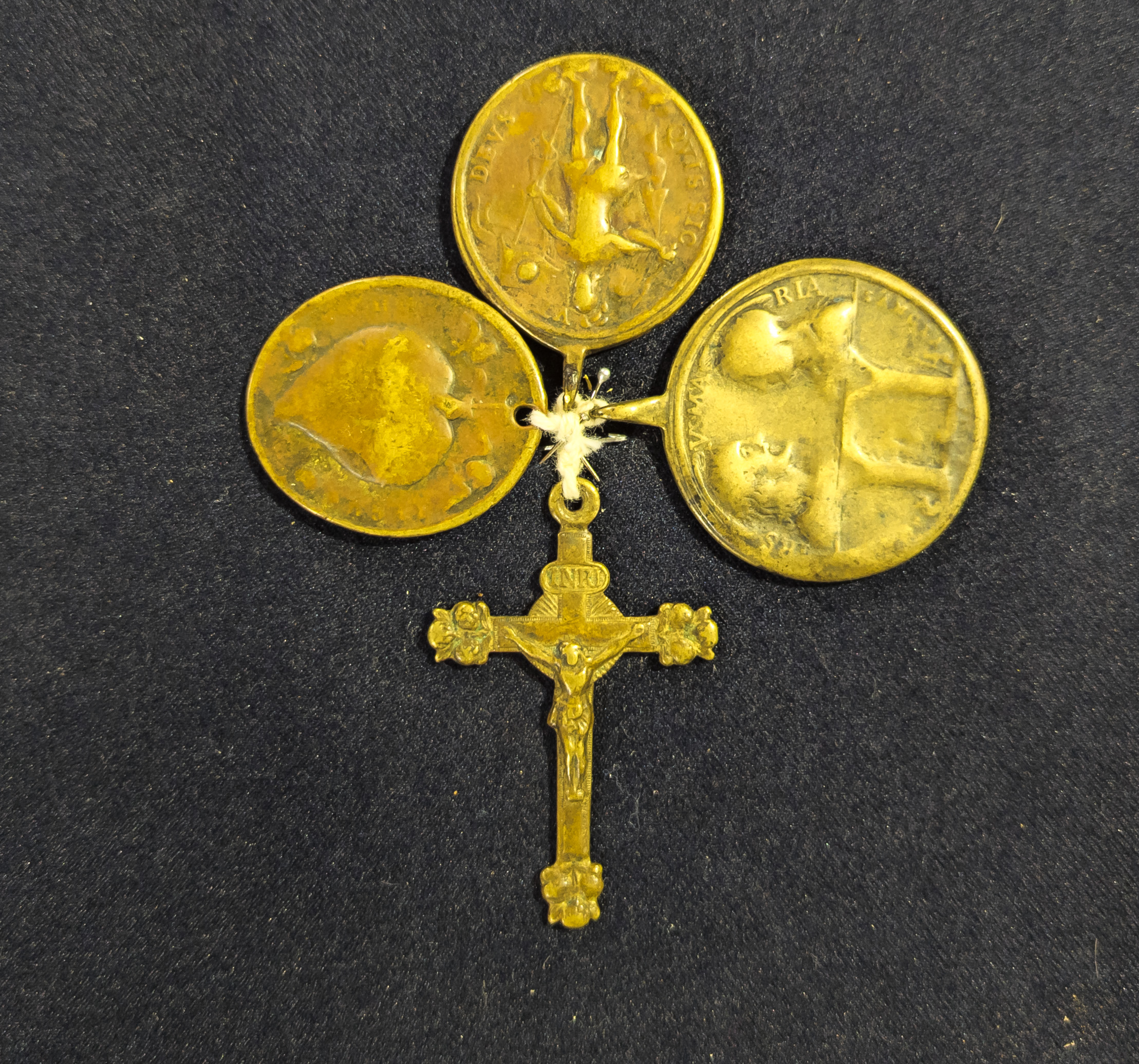
Among the most fascinating objects is Su Giuramentu, a set of bronze medallions with sacred images and a crucifix, used to settle disputes among shepherds, such as theft or pasture trespassing. The person taking the oath would recite a ritual formula; lying was considered extremely serious and was believed to bring misfortune—even blindness. This rite is a powerful example of ancient beliefs that remain alive in collective memory.
The room concludes with a look at Aritzo’s traditional carnival, represented by its animal-like masks: Su Mumutzone, S’Ultzu, and Su ‘Oe. These masks first appear on January 17th, during the feast of Saint Anthony Abbot. Around the great bonfires lit for the night, they move with a measured, rhythmic step, evoking ancient rites and the deep bond between humans, animals, and nature.

This room explores a fundamental aspect of Aritzo’s identity: itinerant trade.
An economy built on movement, relationships, and exchanges—conducted on foot, on horseback, or with carts laden with valuable goods from the forest.
Among the objects on display are tools used by women gathering chestnuts and hazelnuts, as well as those of travelling merchants who transported and sold chestnuts, nougat, timber beams, charcoal, barrels, and finely carved chests.
For Aritzo’s pastoral community, this kind of trade was far more than a simple economic activity: it was a survival strategy, a way to obtain grain and other essential goods, but also an opportunity to open up to the wider world—a channel for social mobility and mutual understanding.
Many transactions took place without the use of money. Barter was the main way of regulating exchanges. Only a few products associated with festive occasions—such as carapigna (a traditional lemon sorbet) or nougat—were bought with coins.
Forest products—chestnuts, walnuts, hazelnuts—were considered everyday food, an essential part of daily life, and were central to the simplest yet most important exchanges.
This section tells the story of one of the most important aspects of Aritzo’s itinerant trade: the harvesting of snow for ice production—an activity that, from the 17th century until the late 1800s, was an exclusive monopoly of the Aritzo community.
The snow concession was established in 1636, as documented in a record preserved in the State Archives of Cagliari dated 1696, thanks to the work of the so‑called Signori della Neve—the “Lords of the Snow”—who were active since the previous century.
Snow was collected and stored in the mountains in special pits dug into the ground, called neviere, and then transported to cities such as Cagliari, where the ice was used to preserve food and drinks or for medicinal purposes.
The ice, cut into large blocks, was insulated with straw and leaves, then placed inside orbace saddlebags. Transport was carried out by horsemen, and each load weighed around 126 kilograms. However, during the journey south, about 40% of the ice would melt, and by the time it reached the port of Cagliari, little more than 50 kilograms remained—ready to be sold or traded.
Part of the ice was purchased by the carapigneris—Aritzo’s sorbet makers—who, during the summer months, travelled across Sardinia to take part in village festivals, selling Sa Carapigna, a traditional sorbet made with water, sugar, and lemon, chilled using snow ice. This artisanal specialty, unique to the Aritzo community, has been part of its heritage since the 1600s.

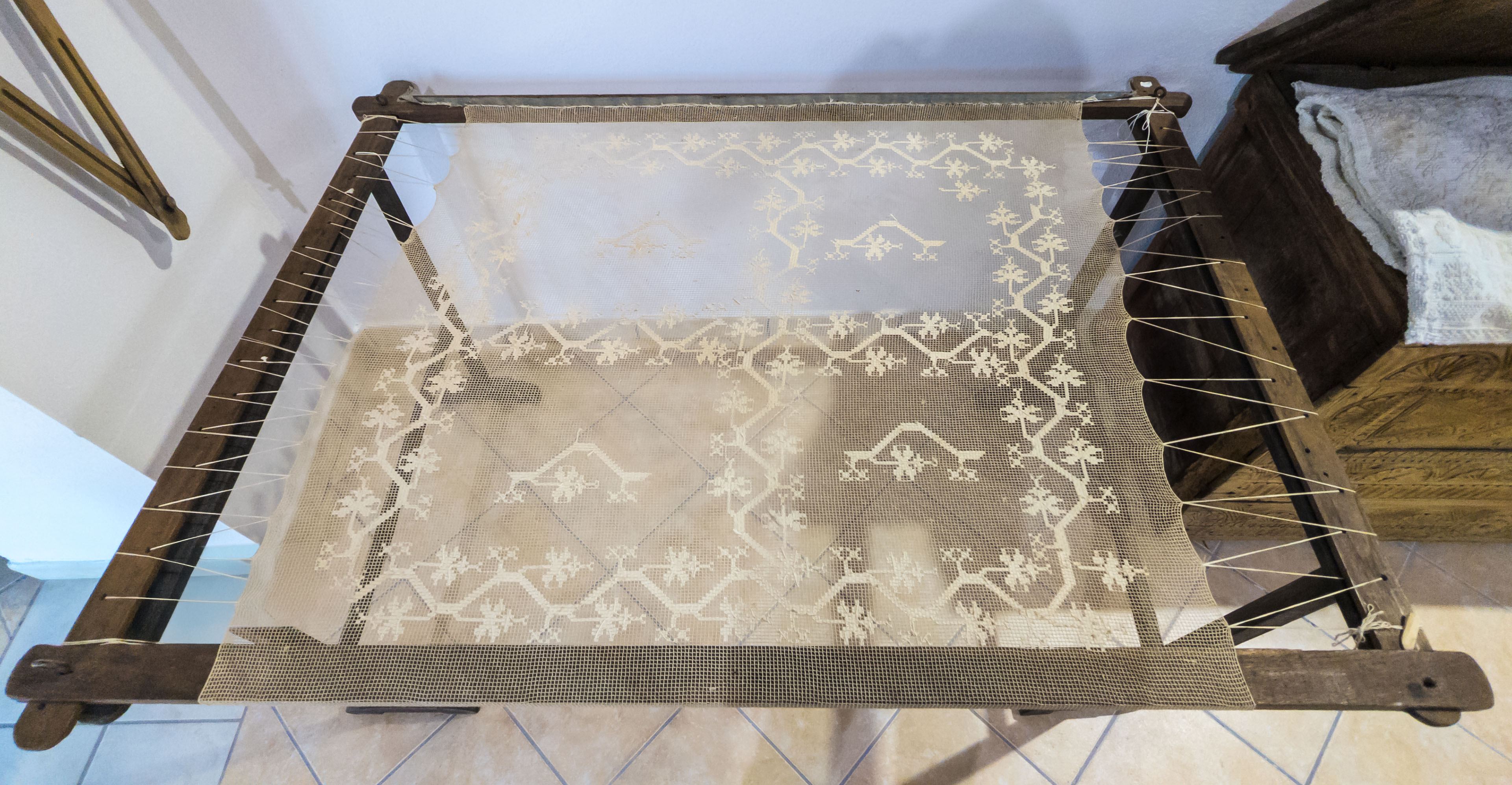
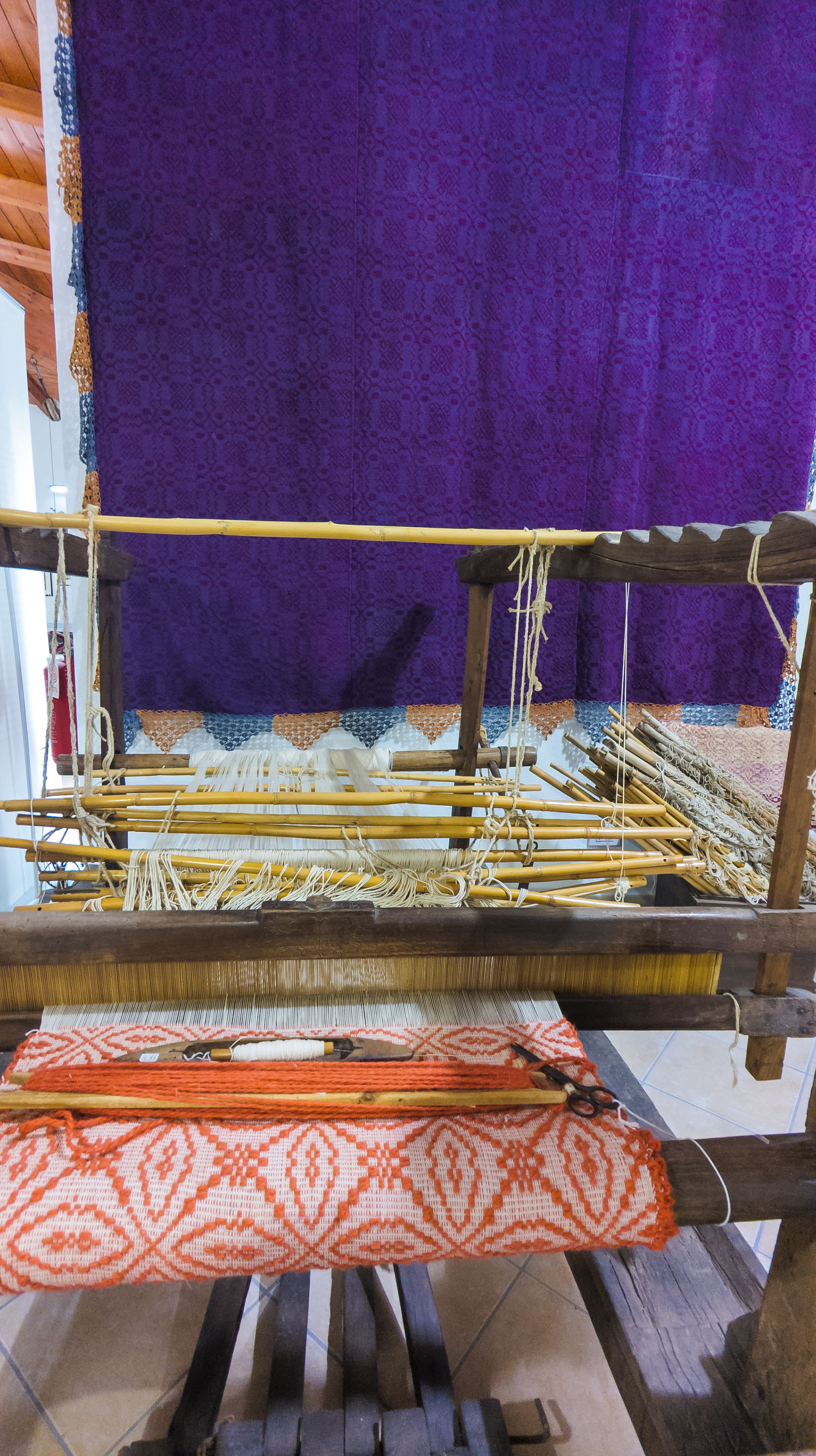
This room is dedicated to the world of women and to the culture of wool, represented along its entire production cycle: from shearing to carding, from raw wool to washed wool, through spinning, dyeing with plant-based essences, and weaving.
On display are all the traditional tools, from the simplest and most rudimentary—such as spindles, distaffs, and wool combs—to various types of spinning wheels and the more complex carding and weaving machines.
Also well represented is the production of woollen goods: from sheets and pieces of orbace—made in varying degrees of quality and refinement for making garments—to blankets, rugs, and tapestries.
But the true masterpieces of women’s craftsmanship are the traditional women’s costumes, shown here in all their many variations: everyday wear, bridal dresses, mourning clothes. Rich in vibrant colours and distinctive forms, these garments speak not only of artisanal creativity but also of the deep cultural identity of the women of Aritzo.

This room presents another aspect of women’s traditional skills: the artisanal working of beeswax.
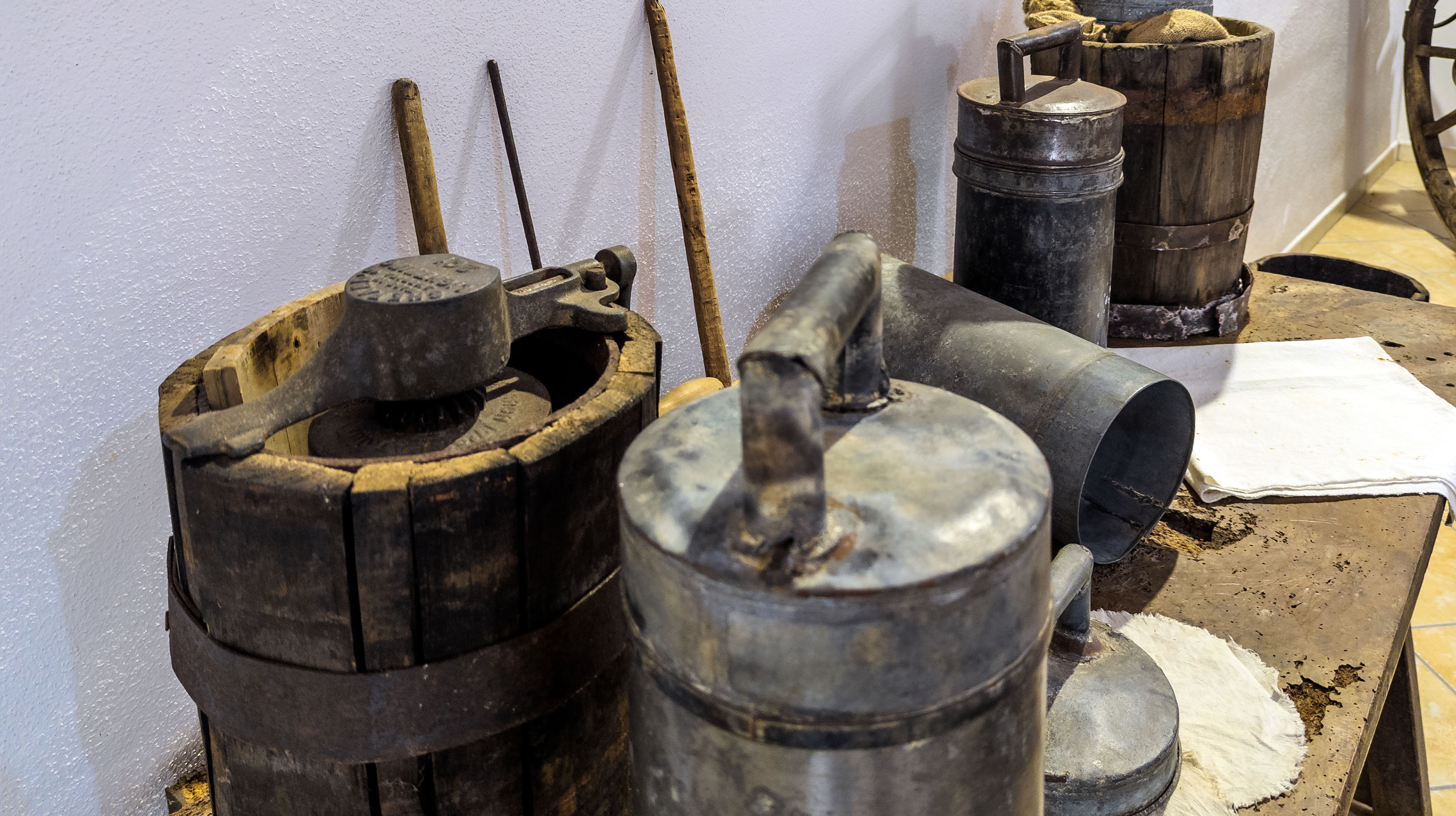
The entire production process is shown, beginning with the extraction of honeycombs from cork hives, followed by the separation of wax from honey, melting, candle-making, and decoration.
On display are all the traditional tools: wooden presses, copper cauldrons, perforated ladles used to remove impurities from the boiling wax, tinned copper containers for pouring, and finally the work table with knives and awls used to decorate the candles.
Completing the display is a 19th‑century carriage, one of the very few that existed in Aritzo at the time.
Several photographs document the procession in honour of Saint Isidore, the patron saint of farmers.

This room is dedicated to the quintessential domestic space: the kitchen of the traditional Sardinian mountain home.
It was not only a place for cooking, storing, and eating food, but also for sleeping and resting. At its centre stands the hearth—the heart of the home—around which mats made of marsh grass were laid out as beds. Above, a suspended rack was used to dry chestnuts.
The room presents the entire bread-making cycle and the processing of chestnuts, displaying a wide range of objects: stone mills and grindstones for grain, flour sieves, kneading troughs, tables and machines for kneading pasta.
There are also baskets in various shapes and materials—such as asphodel, hay, and dwarf palm—along with the traditional wooden and iron oven forks and baking paddles.
An additional section is dedicated to chestnut processing, with tools for drying, shelling, and preparing local dishes.
There is also a display on traditional laundry practices using lye, as well as a collection of carved chests once used to store food and textiles.
The visit concludes with an area dedicated to childhood, featuring traditional cradles, highchairs, walkers, and a selection of toys reproducing miniature farming tools—symbolising how children learned the skills of work from an early age.

The carved chests displayed in this room are all locally made and belong, in both style and form, to the sub‑regional model known as the Aritzo chest, or cassa barbaricina.
Scholarly research has established that, in Sardinia, the production of wedding chests and bridal cassoni in chestnut wood falls into two distinct types: one linked to the Aritzo or Barbagia model, and the other to the Lussurgese model, typical of the Montiferru area.
The importance of the first type has been documented since the 19th century in the writings of travellers, ethnographers, and scholars of Sardinian culture such as Angius, La Marmora, Wagner, and Albizzati. All of them recognised Aritzo as the main centre for the production and dissemination of this type of wooden furniture.
The mountain wedding chest of Sardinia, known throughout its area of distribution—from the Campidano plains to Ogliastra—as the cascia de Aritzu, has been produced continuously for centuries and remains a living tradition.
La Marmora described it as follows:
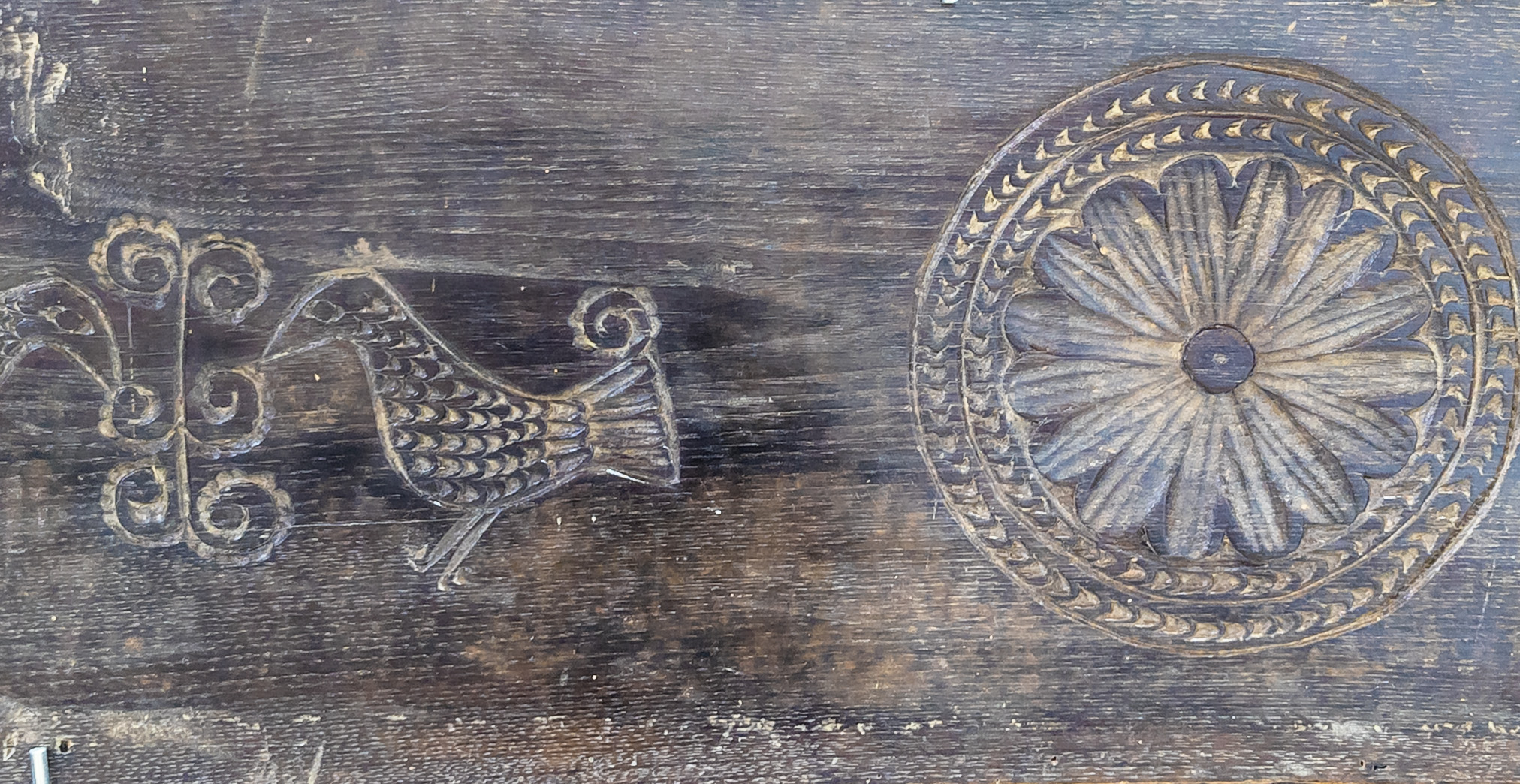
“The other trade of the people of Aritzo (the main one being the snow trade) consists of chests made of chestnut wood, carved with imaginative designs of birds and fantastical animals, which they take to distant villages for sale, carried on horseback.”
The production and trade of the wedding chest represented, alongside snow, one of the most important sources of income for the Aritzo community.
These items held high cultural and symbolic value: they were considered luxury goods and were traded only for cash payment.
Made of chestnut wood, the cassa was highly sought‑after throughout central and southern Sardinia, and used to store linens, clothing, jewellery, bread, and grain—at a time when household furniture was rare and precious.
They were often stained with sheep or goat’s blood, or with red ochre. Over time, the bright colour would darken, both from exposure to hearth smoke and from the natural oxidation of the tannins in the wood.

This room is dedicated to everything connected with Su Padente—the woodland and forest—their resources and their transformation.
It covers not only the gathering of chestnuts and hazelnuts, but also the harvesting of firewood and timber, carpentry, the art of carving wedding chests and cassoni, the extraction of briarwood for pipe‑making, charcoal production, and the workshops of coopers and cartwrights.
The collection of tools on display includes various types of hatchets, axes, and saws: implements of different sizes, shapes, and functions—such as felling axes for cutting down trees, adzes for squaring logs, and saws for cutting planks.
There are also wooden mallets with iron wedges used for splitting logs.
The display continues with reconstructions of artisan workshops, demonstrating the skills of the cooper, the cartwright, and the woodcarver, accompanied by a rich selection of traditional tools and equipment.

This room illustrates the historical organisation of the agricultural landscape, beginning with its division and use—specifically, the biennial or four‑year crop rotation system, based on the subdivision of the village’s arable land between bidatzone and poborile: fields sown with cereals and fields left fallow.
Farming activity, which in Aritzo was never the dominant practice (as late as 1935, of almost seven thousand hectares of land, only 126 were cultivated with cereals), is presented here through its complete set of tools and machines: from the most common hoes to wooden ploughs, ox‑drawn carts, yokes, sickles, sulphur dusters, knapsack sprayers, hay balers, shovels and oven forks for winnowing grain, axes, billhooks, grafting tools, and water containers used in field work, such as cork flasks, gourds, and goatskin water bags.
Introducing this section is the blacksmith‑farrier’s workshop, displaying a wide range of tools used both for forging all the implements of the farming world and for shoeing the domesticated animals employed in agricultural work.
Multimedia