Place details
Casa Devilla
Casa Devilla is an architectural complex that preserves the original Spanish-style structure, despite being the result of multiple construction phases. It was once the residence of the Devilla family, members of the agrarian and professional bourgeoisie, who—starting in the 1800s—were contractors for the so-called "snow industry" and known as the “Lords of the Snow.” This trade involved the collection and export of snow-turned-ice, and lasted until the activity eventually disappeared.
The storage and sale of snow ice was one of the pillars of the local economy. Snow was collected and stored in special underground pits, then sold in cities, where it was used to preserve food and chill beverages. The ice trade was run under a monopoly, and the contractors were required to provide free ice to the Royal Palace of Cagliari, as specified in their contracts.
Snow collection was carried out by the niargios—the skilled workers who gathered and packed the snow into pits called neviere. These were stone-lined holes dug into the ground, up to three meters deep and between seven and fourteen meters wide. The snow was compacted, covered with ferns and brush, and kept cool for months. In summer, it was cut into blocks, insulated with straw, and transported on horseback and by cart across Sardinia.
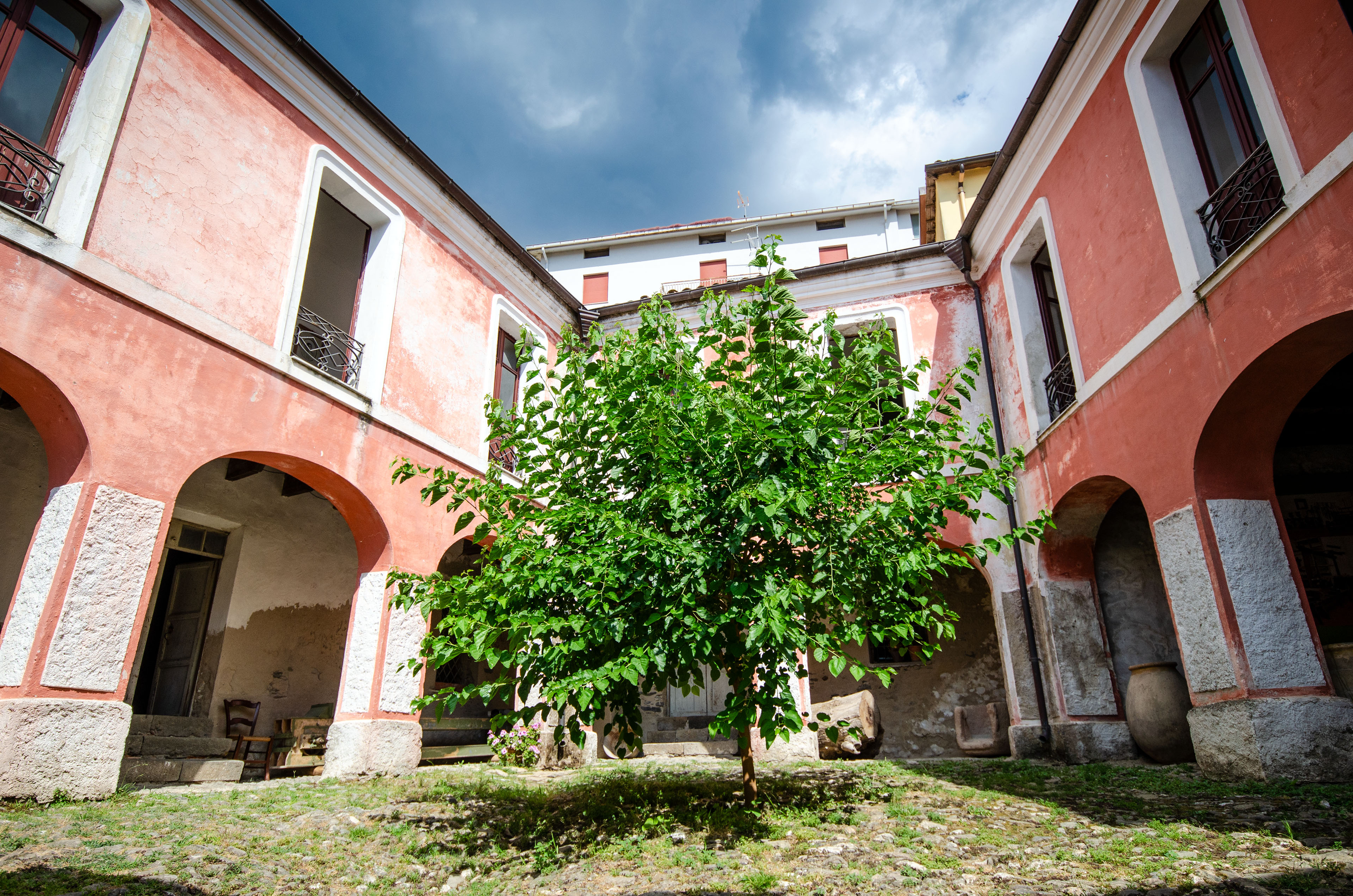
The house is built on three levels and is entered through an imposing stone portal built in 1889. This leads to a trapezoidal courtyard, which enhances the scenic effect thanks to the perspective of the space. The richness of the building highlights the social status of the Devilla family within the Aritzo community.
The oldest part of the house, to the left of the entrance, dates back to the 17th century and reflects the typical features of Gennargentu mountain homes—both in materials (schist stone and chestnut wood) and in structure (a wooden balcony later enclosed to form a corridor). The presence of Venetian-style coffered ceilings—even in the food storage cellars—attests to the noble origins of the family.
In 1853, the vernacular poet Bachisio Sulis was killed in the courtyard of the house in an ambush.
Via Is Alinos, 3, 08031 Aritzo NU, Italia
Map
Visit guide

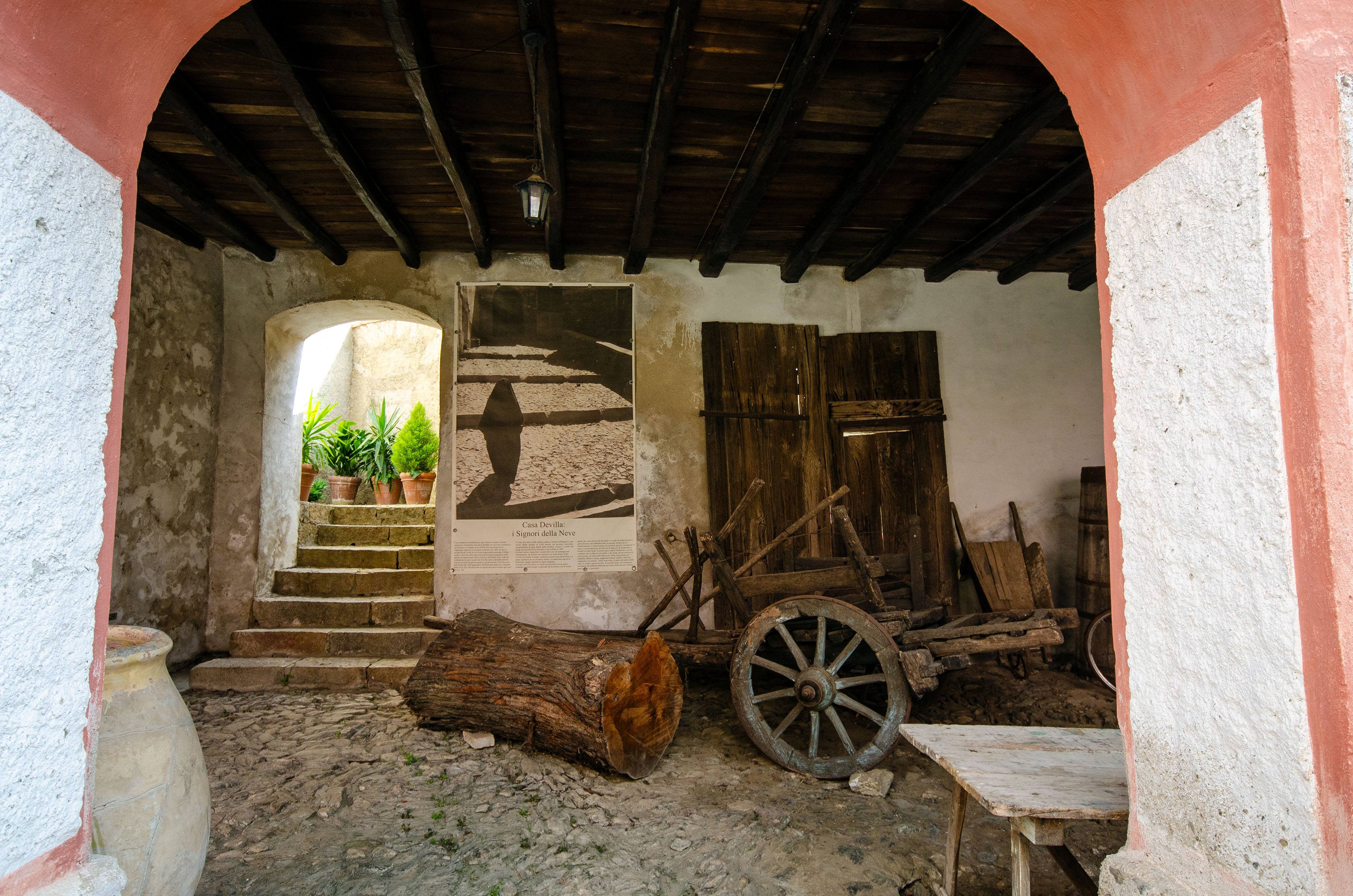
On the ground floor of Casa Devilla are the storage rooms, traditionally known as is funnagoso. This was the coolest part of the house, once used for processing and storing agricultural products. A particularly interesting area is sa fossa 'e sa castagna—the chestnut pit—where fresh chestnuts were kept. They were laid on a bed of arbutus branches to avoid direct contact with the ground and preserve their quality.
Chestnuts, often referred to as “the bread of the poor,” are an ancient staple and have always played a key role in both the diet and economy of the people of Aritzo. Even today, the figure of the biaxante survives—an itinerant merchant who travels from village to village across Sardinia, selling local products like chestnuts, hazelnuts, walnuts, and, in the past, hand-carved wooden chests.
Chestnuts are highly valued throughout the island, and Aritzo has long been known as “the chestnut village.”
In this room, cheese was also aged, placed on suspended wooden planks. During the warmer months, the cheese was moved into the muschera, a protective mesh covering that shielded it from flies and prevented spoilage.
Hanging on the wall is the stadera, the traditional scale used to weigh blocks of ice before sale. Other tools are also on display, including milk transport containers and a cork vessel used for milking, known as the mussolgia.

This room displays the tools used for winemaking. In Aritzo, there were many cooper artisans who made vats and barrels using chestnut wood—an ideal material for winemaking due to its high tannin content. Before the grape harvests, coopers would travel to nearby villages to repair barrels they had previously sold or simply to offer their skills and labor.

This section focuses on chestnut harvesting and the use of chestnut wood. The local territory includes two main chestnut-growing areas: the first is the forest surrounding the town, made up mostly of coppice woods, called cugnaos—enclosed plots. The second area consists of mountain chestnut groves, known as is orroas, originally open and used for both timber and fruit. Of the two, the first area is the largest.
The trees were felled in winter, shaped with axes, cut into large planks, and left to season outdoors for several years. The cured wood was then used in local workshops to make carved chests, barrels, and other handcrafted items.
The oldest and most majestic chestnut forest is called Geratzia, where some trees are over nine hundred years old.
Chestnut harvesting follows a flexible calendar, alternating workdays and rest, depending on weather conditions and how the fruit ripens from year to year.
To make the chestnuts fall more easily, a technique called maxiare was used: it involved hitting the trees with long poles. This demanding work was done mostly by men, but sometimes by women as well.
After a first round of harvesting the fallen chestnuts, a pause would follow—waiting for more to drop. This cycle was repeated as needed. Harvesting had to be quick, especially in years with delayed seasons, to ensure everything was completed by the end of October.
In the past, when harvesting in groves far from the village, workers would stay in place to guard the chestnuts, storing them in open-air pits to protect them from animals.

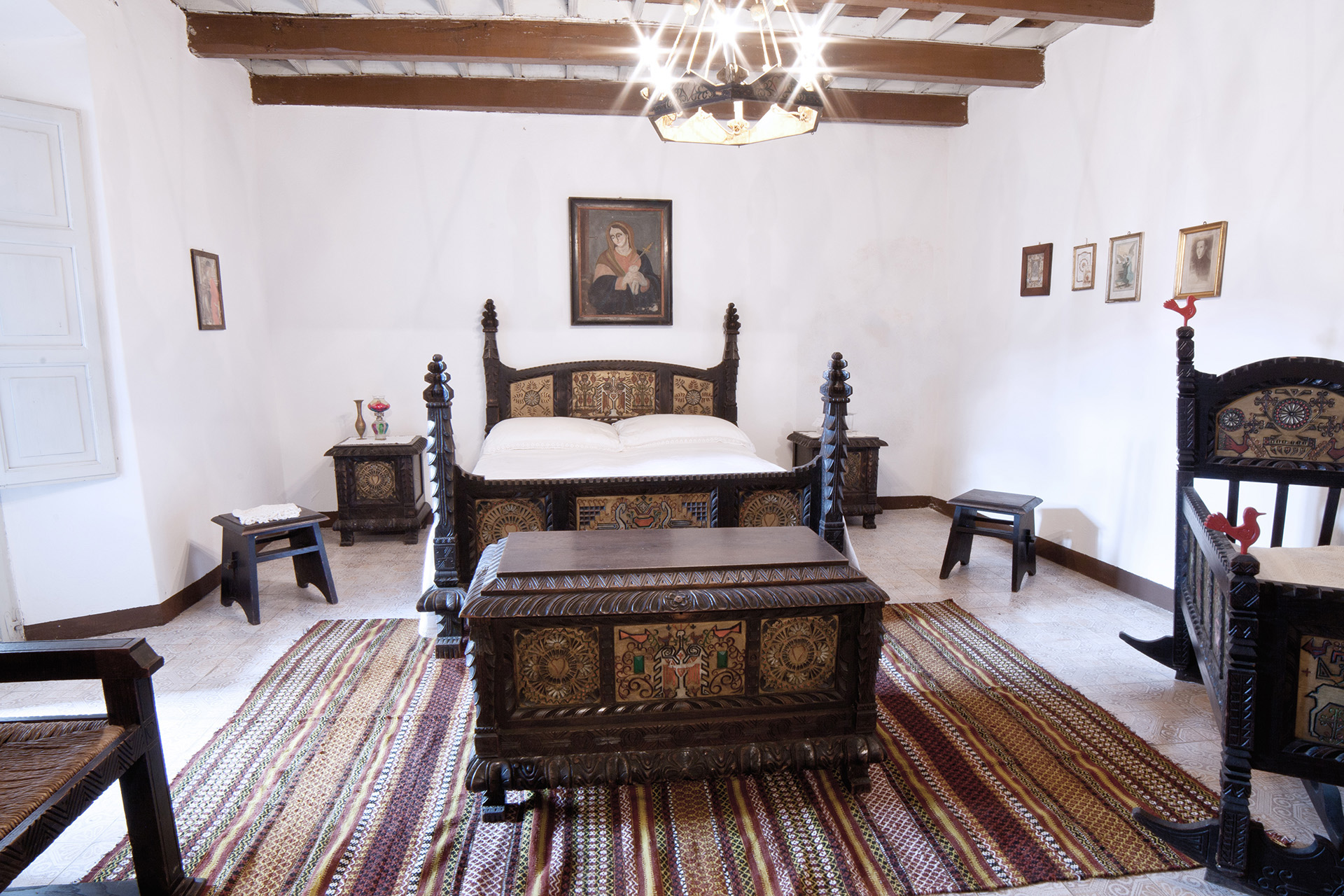
At the beginning of the 20th century, the bedroom became a private space, no longer shared with the rest of the family. During this time, eclectic furnishings appeared, blending different stylistic elements. A remarkable example is the bedroom designed by Antonio Mura, painter and artist from Aritzo, and crafted in chestnut wood by local artisans.
The room was commissioned by the artist himself in 1926 as a wedding gift for his brother. It is a refined example of Sardinian Art Deco: carved furniture with motifs inspired by tradition, reinterpreted in a modern key.
What might have seemed sombre in this kind of furniture—due to the common use of black varnish—is softened here by a warm brown tone, achieved using goat’s blood, and above all by the addition of brightly coloured inlays.
The bed headboards are magnificent: the uprights are carved with lily-leaf patterns that recall the spires of Gothic cathedrals, late Gothic Sardinian altarpieces, and—with a touch of modernism—even the forms of Gaudí’s Sagrada Familia.
The cradle is enchanting, topped with four delicately carved red birds, gently perched on the tips of its posts—a tender and poetic detail that adds grace and lightness to the entire room.

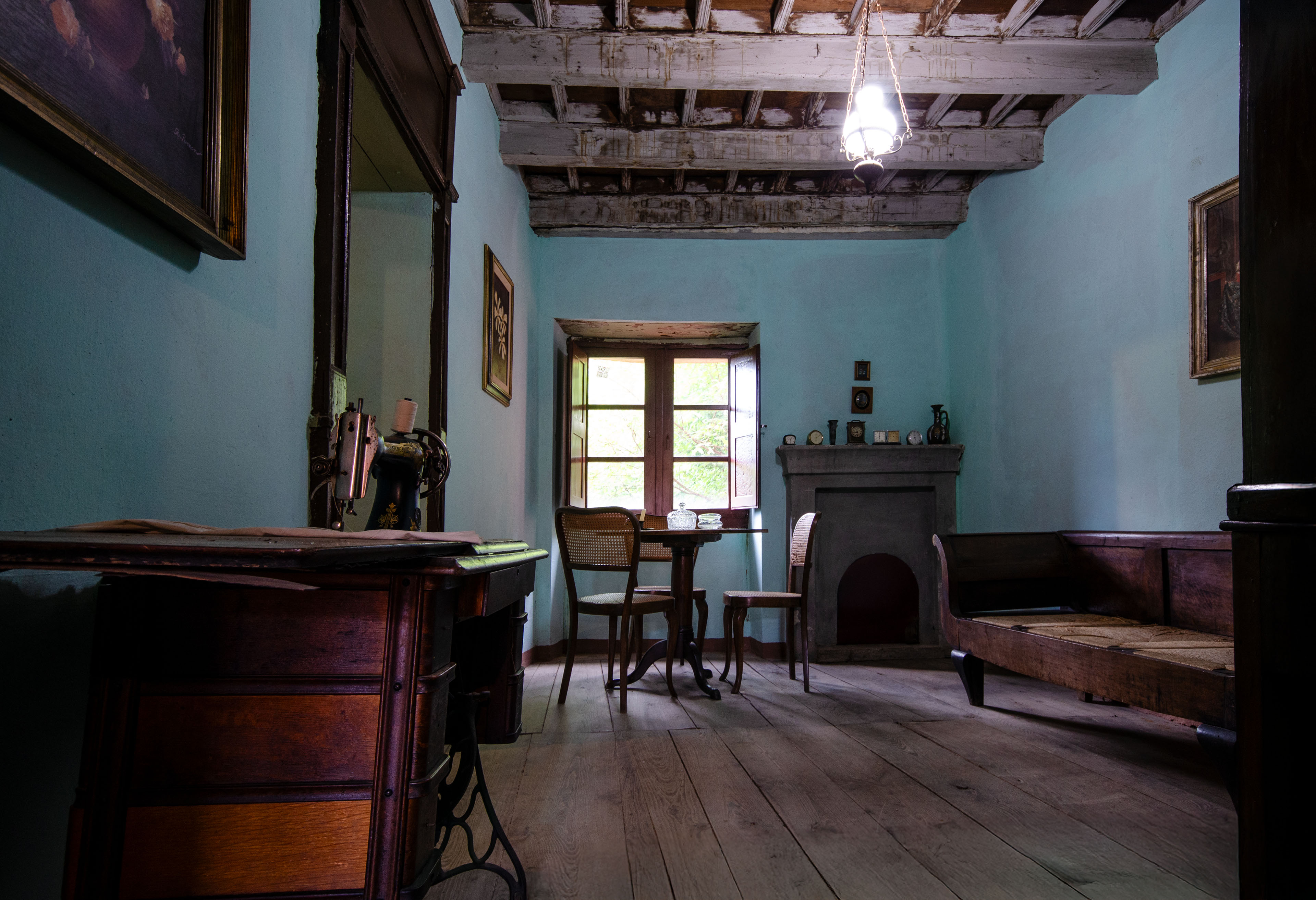
The small sitting room is warmed by a small fireplace. The wooden canapé with a woven straw seat dates back to the early 20th century. The chairs are made with Vienna straw. In one corner, an early Singer sewing machine bears witness to the ingenuity and industriousness of the time.
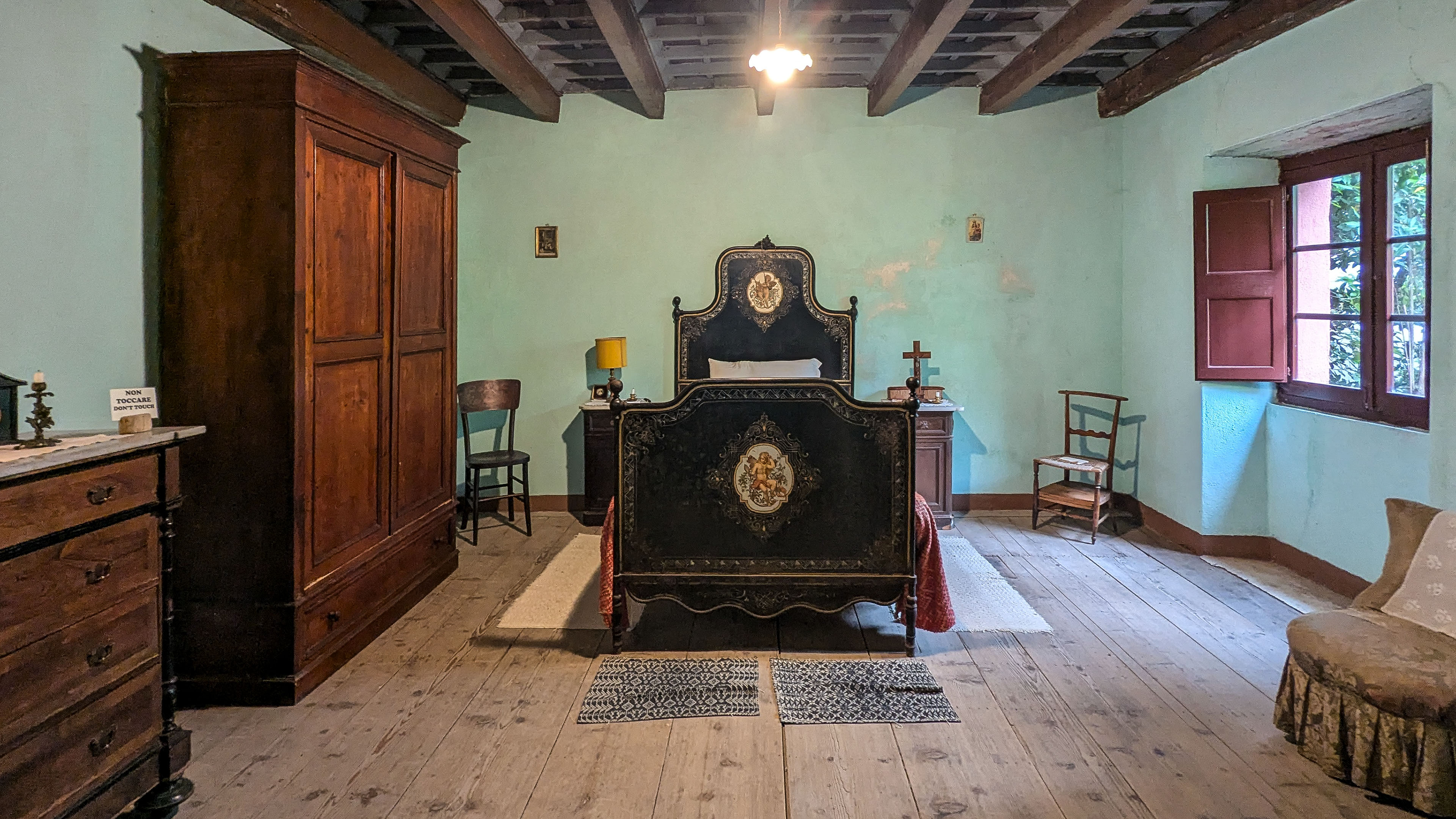
From the sitting room, you enter a second bedroom, furnished with pieces from the first half of the 20th century. The French-style bed, smaller than a standard double, features a headboard and footboard in iron, adorned with mother-of-pearl inlays. The embroidered pillowcases are marked with the initials of the Devilla family.
Resting on the bed is the prete, a bed warmer that was filled with hot embers from the fireplace or hearth. For safety, it was placed inside the so-called monaca—a wooden frame made of two curved planks resembling the shape of a boat. It lifted the sheets and prevented them from burning.
Elegant and refined, the wooden washstand with a marble top and mirror is quite different from the simple iron basin stands once common in every home. Beside it, a prayer chair used by women both at home and in church bears the owner’s initials carved into the wood.
Hanging on the coat rack is a small white bodice—an early form of brassiere. Unlike modern versions, it didn’t cover the breasts but supported them, just like the cosso, the bodice of the traditional Sardinian dress.
The kitchen displays various antique and vintage furnishings and objects. The large wooden chest, plain and without carvings, was used to store grain. Baskets and panniers of different shapes and uses are woven from natural materials such as asphodel, straw, and reed.
On the table sits a wooden madia—a kneading trough used to mix flour with water and other ingredients for bread or pasta. The table itself, commonly known as sa mesa de su pane—“the bread table”—was used for all activities related to breadmaking and preparing sweets.
Next to the table stands a torchio bigolaro, a cast-brass pasta press used to make fresh pasta. The white-painted cupboard, affectionately known as il mobiletto, was a staple in most Italian kitchens.
By the window is the bread-making worktable, complete with a kneading machine (gramola) used to mix the dough evenly. In the display case, you can see hand-carved wooden cutlery. On the mantelpiece, typical 20th-century enamelled iron coffee pots are on display, along with terracotta pitchers.
In this house, the old squat toilet was connected externally to a septic pit. Having an indoor bathroom was once a true luxury, reserved for the few. Until the 1950s, bathrooms were often built as separate structures, and in mountain homes, they were sometimes placed on the external wooden balconies.
On the wall to the left of the bathroom, you can see an example of a traditional construction technique: a wall framework made from chestnut branches, covered with lime mortar.
In the hallway, a wooden staircase leads up to the attic. This space was once reserved for servants’ quarters and for storing food supplies such as walnuts and hazelnuts, to be preserved over the winter.

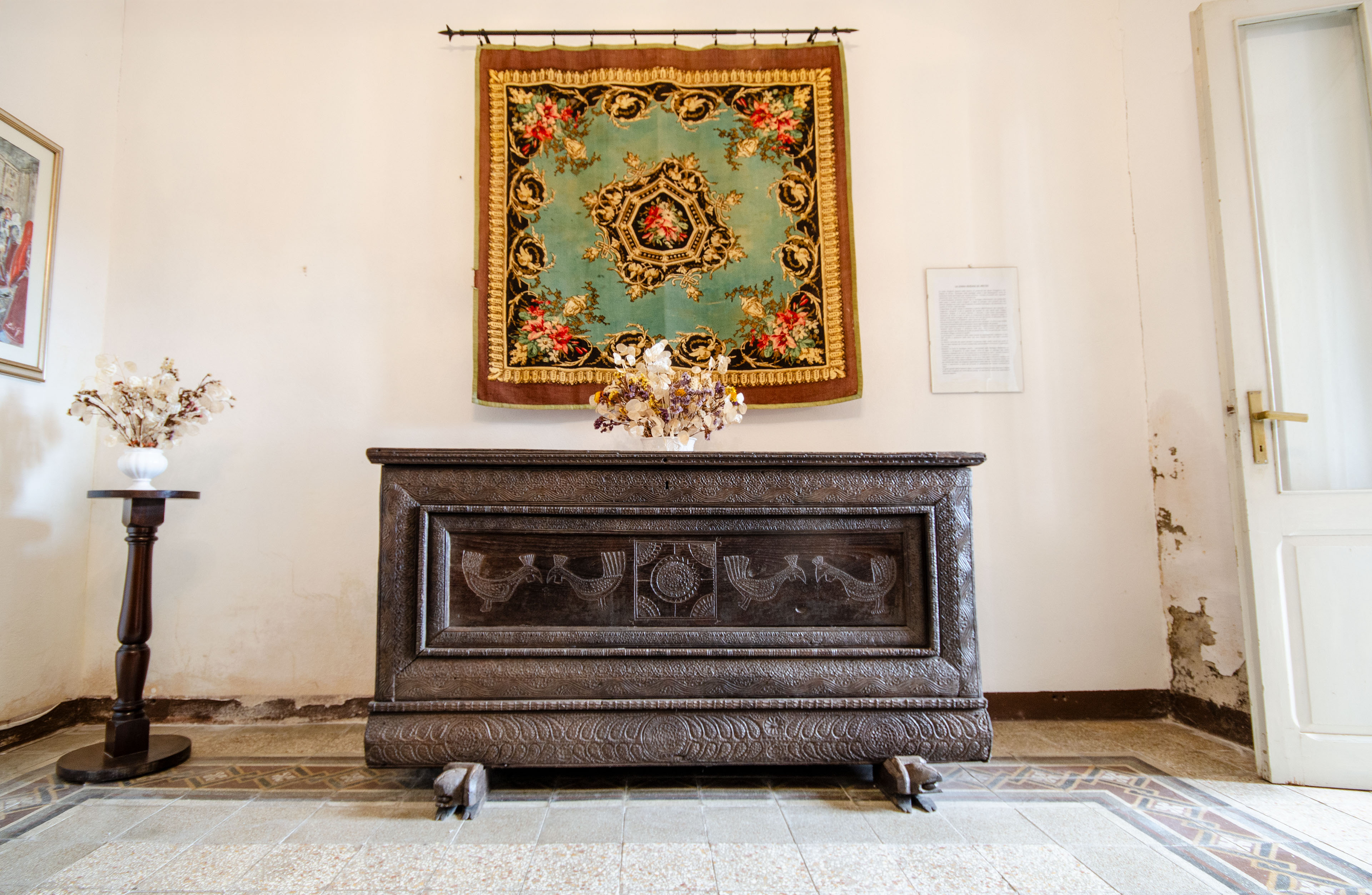
The carved chestnut wood chests, known in Sardinian as cascias or alceddas, are among the most iconic furnishings of Aritzo’s artisan tradition. Wood carving is an ancient technique, documented by scholars and ethnographers since the 19th century.
These were bridal chests, used to store a bride’s trousseau—her dowry, linens, clothing, jewelry, or grains. The production and trade of these chests, along with the snow trade, were important to the local economy. Considered luxury items, they were sold exclusively for cash.
The chests were made entirely of chestnut wood, stained with sheep or goat blood, or with red ochre. Over time, the bright color darkened due to smoke from the hearth and the natural oxidation of the tannins in the wood.
On the front panel—called sa mosta—you’ll find traditional Sardinian decorative motifs. The central rosette, an ancient symbol also used by the Ottomans, represents the drops of Christ’s blood in Christian iconography. The pavoncella, introduced by the Byzantines in the 6th century, is a good luck charm, symbolizing fertility and, in Christianity, the immortality of the soul. Other recurring symbols include wheat ears, representing wishes for prosperity.
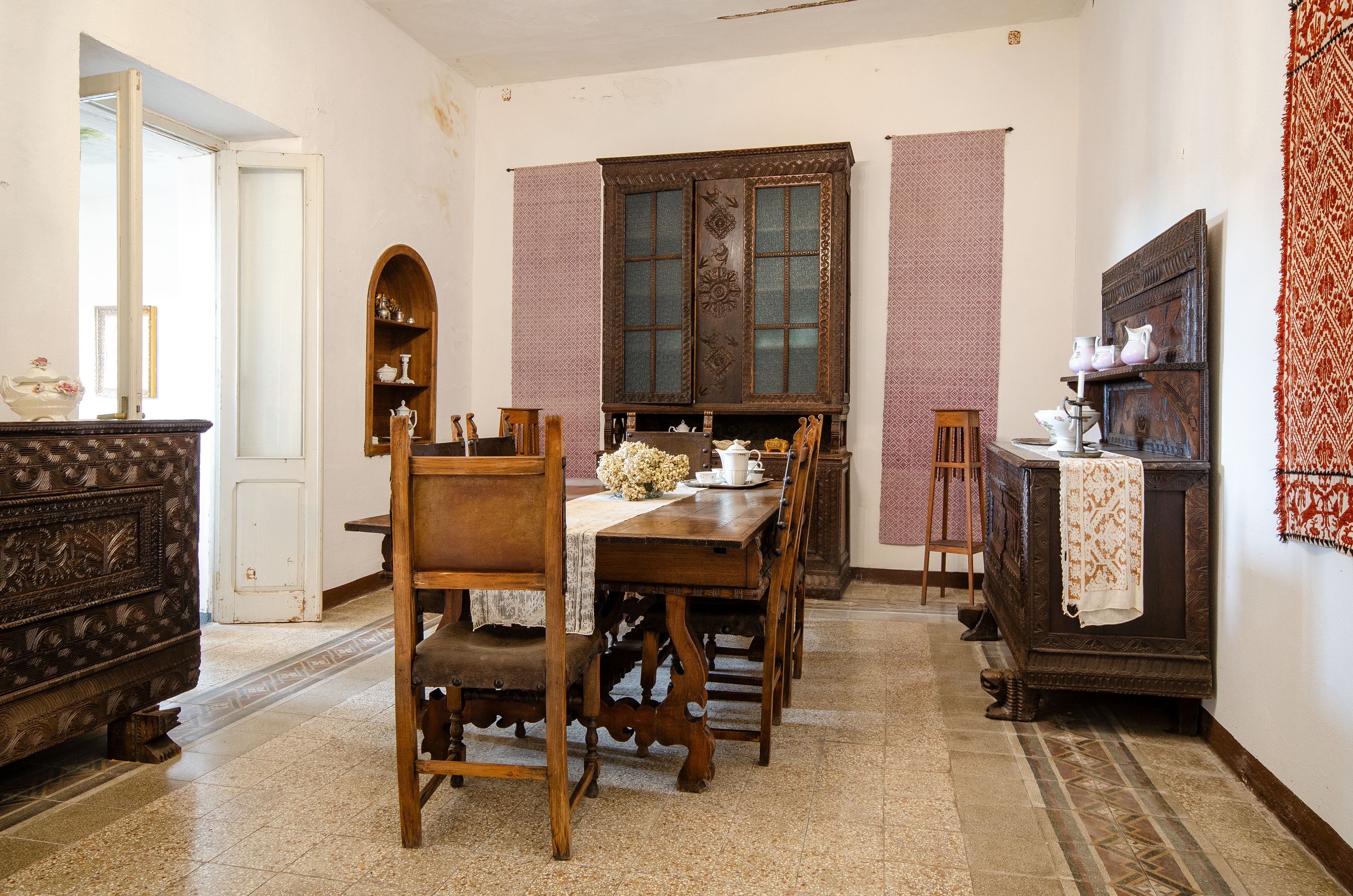
The chests opened only from the top and stood on carved feet shaped like turtles or lions. The dining room, made entirely of chestnut wood, dates back to the 1930s. The lower parts of the sideboards are in fact modified antique chests, adapted with front openings—a more elegant style popular in upper-class homes. The room is decorated with handwoven Sardinian textile art rugs hung on the walls.

This room is furnished with two elegant late 19th-century bookcases in the Art Nouveau style. Inside are several medical books, reflecting the fact that some members of the Devilla family worked in pharmaceuticals, along with older texts on the history of the Catholic Church, written in Latin and French.
The room has no fireplace; to keep warm, a copper brazier—called sa cupa in Sardinian—was used, resting on a wooden stand.
On the wall hangs a map of Sardinia, a copy of the one created by geographer Alberto La Marmora, one of the first scholars to study the island’s natural history and archaeology.
The photograph shows Giuseppe Luigi Devilla, mayor of Aritzo from 1887 to 1889 and author of the book La Barbagia e i Barbaricini, published in 1889, in which he describes the Barbagia di Belvì at the end of the 19th century.

This room houses two carved chests dating back to the late 17th century.
As in most rooms of the house, there is a small fireplace—the only source of heating in the past.
Hanging on the wall is a large textile piece known as a fressada or burra, handwoven with wool dyed using plant-based essences. This traditional craft comes from nearby mountain towns and villages such as Tonara and Gadoni.
The small yellow and brown tapestry originates from the weaving tradition of the town of Isili.
Finally, the radio on display is a model from the 1930s.
Multimedia